Friend and fellow Guild officer Daniel Duffy is starting a project in West Philly that will train youth how to keep bees. They will also sell their beehive products at farmers markets in Philly. Watch the video below and if you are so inclined, make a donation to this project by clicking on the "KICKSTARTER" link in the lower right-hand corner of the video -
Saturday, February 5, 2011


Saturday, January 22, 2011
CSI: Francisville
Well, unfortunately my suspicions were confirmed. Someone was indeed meddling with at least one of the hives that recently died. How do I know, you may ask? Well, I broke down the hives in order to do a post-mortem and to see if I could determine the cause of their demise. As I was taking down one of the hives at the park, I quickly noticed that one frame was missing from one of the boxes - hmmm, I thought, it is unlikely that I neglected to replace a frame during my inspections, but hey, anything is possible. When I got everything home and took a closer look, I saw that it was actually two frames that were missing. Now, I might be forgetful sometimes, but there is no way that I put a hive back together with two whole frames missing. Then, as I continue to examine the hive, I see this -

The honeycomb from this frame was cut out - look closely and you can see the thin vertical wire from the foundation in the middle of the frame. Someone just went and cut out the comb - amazing!
When I saw the frame with the comb cut out of it, I was kind of in shock. It took me a few seconds to figure out what I was looking at, because I never expected to see something like this. So, this confirmed it beyond the shadow of a doubt. There's a honey thief in my 'hood!! More important than the pilfered honey is that I will never know how often this person was messing with the hives and I'll never know how much of a role that played in the death of these hives. So I don't stand to learn much about beekeeping from this, except that I need to be much more careful about hive placement in the future. Here is a picture of part of the tiny cluster that I found in the robbed-out hive, there were so few bees in there it was sad -

The other hive had quite a bit more bees in it (though not a ton) and no obvious signs of tampering, so who knows what killed them. There was still a lot of honey and pollen left in both hives, so the thieves did not take it all. The drawn comb and all of that surplus honey (about 3 medium supers full) will give my new bees a great head start in the spring. And if necessary, I can feed this honey to my other existing hives if they are running low.
Just another day in the wacky world of beekeeping in the city, I am undeterred...

The honeycomb from this frame was cut out - look closely and you can see the thin vertical wire from the foundation in the middle of the frame. Someone just went and cut out the comb - amazing!
When I saw the frame with the comb cut out of it, I was kind of in shock. It took me a few seconds to figure out what I was looking at, because I never expected to see something like this. So, this confirmed it beyond the shadow of a doubt. There's a honey thief in my 'hood!! More important than the pilfered honey is that I will never know how often this person was messing with the hives and I'll never know how much of a role that played in the death of these hives. So I don't stand to learn much about beekeeping from this, except that I need to be much more careful about hive placement in the future. Here is a picture of part of the tiny cluster that I found in the robbed-out hive, there were so few bees in there it was sad -

The other hive had quite a bit more bees in it (though not a ton) and no obvious signs of tampering, so who knows what killed them. There was still a lot of honey and pollen left in both hives, so the thieves did not take it all. The drawn comb and all of that surplus honey (about 3 medium supers full) will give my new bees a great head start in the spring. And if necessary, I can feed this honey to my other existing hives if they are running low.
Just another day in the wacky world of beekeeping in the city, I am undeterred...
Thursday, January 13, 2011
Winter is Here
So it looks like this winter is shaping up to be just like last year, lots of snow. We've already had 3 little storms, nothing like last year's blizzards but still Philadelphia has already surpassed it's average annual snowfall of 20".
So much has happened since last I wrote, I'm not sure where to start. I guess the bad news first. The two hives in the little park where the tree was cut down have already died (these were the awesome bees from Vermont). I was worried about them being kind of small in population and I guess I was right. There was still honey in the hive so they didn't starve. I am pretty sure some unknown person/people were messing with the hives. There were several times when I went to check on these hives and I could tell that things were not as I left them. I also got reports from others that they saw people "leaning on the hives" - hard to imagine but stranger things have happened. This situation was not helped by the fact that the chain-link fence surrounding this park was destroyed by the tree removal and this allowed anyone to just walk right up to the hives.
I was pretty bummed by the loss of these bees and by the overall failure of this site but the silver lining to the dead bees is that they made lots of nice, drawn-out honeycomb last year. This drawn comb is a valuable resource and it will help my new bees to get a quick start on building their new home. I was planning on moving these 2 hives to Woodford Mansion in East Fairmount Park, but since they didn't make it, instead I have ordered 2 new packages of bees from the Seaborns and will install them at Woodford in early April.
My 3 other hives appear to be doing well. On a recent warmish day in December the bees in my home hive were busy cleaning house. They were dragging out the dead and relieving themselves in the snow. When we were out on the roof one little bee landed on Jolie and proceeded to poop right on her shirt! Hopefully these 3 hives survive the winter.
This spring I am hoping to do more bee removals and swarm captures. This will help me to either grow my apiary or be able to provide other beekeepers with some bees.
As a follow-up to the the Langstroth celebration and Honey Fest, which was a huge success, the Guild is bringing Ross Conrad to speak in Philadelphia in February. Ross is the author of Natural Beekeeping, which is a book on keeping bees using organic management techniques. Registration has already begun and it looks like it is going to be a great turnout.
There's more to write but I just wanted to get a quick update written. Stay tuned...
So much has happened since last I wrote, I'm not sure where to start. I guess the bad news first. The two hives in the little park where the tree was cut down have already died (these were the awesome bees from Vermont). I was worried about them being kind of small in population and I guess I was right. There was still honey in the hive so they didn't starve. I am pretty sure some unknown person/people were messing with the hives. There were several times when I went to check on these hives and I could tell that things were not as I left them. I also got reports from others that they saw people "leaning on the hives" - hard to imagine but stranger things have happened. This situation was not helped by the fact that the chain-link fence surrounding this park was destroyed by the tree removal and this allowed anyone to just walk right up to the hives.
I was pretty bummed by the loss of these bees and by the overall failure of this site but the silver lining to the dead bees is that they made lots of nice, drawn-out honeycomb last year. This drawn comb is a valuable resource and it will help my new bees to get a quick start on building their new home. I was planning on moving these 2 hives to Woodford Mansion in East Fairmount Park, but since they didn't make it, instead I have ordered 2 new packages of bees from the Seaborns and will install them at Woodford in early April.
My 3 other hives appear to be doing well. On a recent warmish day in December the bees in my home hive were busy cleaning house. They were dragging out the dead and relieving themselves in the snow. When we were out on the roof one little bee landed on Jolie and proceeded to poop right on her shirt! Hopefully these 3 hives survive the winter.
This spring I am hoping to do more bee removals and swarm captures. This will help me to either grow my apiary or be able to provide other beekeepers with some bees.
As a follow-up to the the Langstroth celebration and Honey Fest, which was a huge success, the Guild is bringing Ross Conrad to speak in Philadelphia in February. Ross is the author of Natural Beekeeping, which is a book on keeping bees using organic management techniques. Registration has already begun and it looks like it is going to be a great turnout.
There's more to write but I just wanted to get a quick update written. Stay tuned...
Wednesday, September 15, 2010
Interview, Video and Pics from Honey Fest
I recently did an interview with Bradd DelMuto for his Philly based blog 22nd and Philly. Have a look at the interview and the rest of Bradd's blog here.
Also, Philadelphia Honey Fest happened last weekend and it was a huge success. Here are some pictures and a video montage of the weekend events. And here is a great story from a Temple journalism student.
Also, Philadelphia Honey Fest happened last weekend and it was a huge success. Here are some pictures and a video montage of the weekend events. And here is a great story from a Temple journalism student.
Friday, September 10, 2010
Get Outta My Bedroom!
Earlier this summer I got a call about some bees living in a house in Southwest Philadelphia. I went to check out the situation and what I saw was hundreds of dead bees (and some live ones) in what used to be a 6 year-old's bedroom (he hadn't stayed in his room for 6 months because of the bees). There was even honey dripping through the ceiling and landing in a honey puddle on the floor. The bees were entering the house through the flashing of the exterior roof and they had made their home in the ceiling of the bedroom. As far as we could tell, the bees had been there for at least one-and-a-half years. In order to remove the bees we'd have to rip open the ceiling, cut out all of the honeycomb and get all of the bees out of there.
More hands make easier work so I enlisted the help of world famous president of The Philadelphia Beekeepers Guild, Joel Eckel. We had a great time and everything went amazingly smooth. The first order of business was to locate the hive exactly and determine how big it was, which meant opening up the ceiling (remember you can click on images to enlarge them).


Believe it or not, the bees were pretty damn calm, especially given that we were completely destroying their home. After getting an idea of how large the hive was and where its boundaries were, we began gathering the bees. The easiest and best way to do that is with a vacuum - yes, a bee vacuum. There are many different variations of the bee-vac out there, but the one I purchased is basically like a wooden hive body that gets hooked up to a shop vac. The bees get sucked into the hive body and theoretically hang out in there until you take them to their new home (later you'll see why I say "theoretically") . Unfortunately I didn't get a good picture of the bee vac but here's a little demo:
That huge chunk of honeycomb that you see in the beginning on top of the bucket was packed with a few pounds of honey. After vacuuming a big bunch of bees, Joel began cutting the comb off of the ceiling and the walls. If the comb was filled with honey, we put it in a bucket to deal with later. We harvested about 40 pounds of honey from this hive, most of which will be fed back to these bees or to my other bees if they need it. If the comb was filled with brood, we tried to preserve it by rubberbanding it into frames so that it could be placed into a hive body. Here's how that went:
So we would vacuum some bees, cut out some comb and repeat. It took us about 4 hours in total. That included some help from the owners of the building, Alex (video below) and Chris (pic below). They really got into it and were amazed by the bees and the process of removing them.

Once we cut out all of the comb and vacuumed as many bees as possible, we cleaned up and left. We knew that many of the forager bees were out foraging and would return later in the day. So I returned to the house after dusk and there were a few more softball-sized clusters of bees hanging out near the window. I did one last vacuum job and then packed up for home. After my traumatic swarm incident, I wanted to get these bees set up in a new hive ASAP. I brought the hive body with the rubberbanded brood frames and I put it on my roof, where this hive would live for the time beeing.
I went to dump the bees out from the vacuum box into the new hive and was shocked and dismayed to see that once again, a lot of the bees were dead.


So, bee carnage part 2? Well, it wasn't quite as bad this time. It seemed like there were enough living bees that this hive might have a fighting chance to re-establish itself. But, in retrospect I do think that the bee vacuum box was just way too small and there were too many bees in there and it was too hot. Nonetheless, in the days following the relocation, the bees seemed to be adjusting to their new home.
Much to my delight, when I checked on the bees earlier this week, they had made some queen cells in an effort to replace their deceased queen. They had also begun to secure the comb into the frames. You can see a video of me checking on this hive and an excellent article on urban beekeeping right here. I am also feeding their honey back to them.
The chances that this hive will make it through the winter are still slim - mainly because their population was so decimated and they will lose a few weeks of growth due to the fact that they needed to make a queen from one of the existing larvae. But, you never know and worst case scenario is that I have 40 pounds of surplus, chemical-free honey to feed my other bees AND most importantly, the little boy who lost his bedroom to the bees can now have it back!
More hands make easier work so I enlisted the help of world famous president of The Philadelphia Beekeepers Guild, Joel Eckel. We had a great time and everything went amazingly smooth. The first order of business was to locate the hive exactly and determine how big it was, which meant opening up the ceiling (remember you can click on images to enlarge them).


Believe it or not, the bees were pretty damn calm, especially given that we were completely destroying their home. After getting an idea of how large the hive was and where its boundaries were, we began gathering the bees. The easiest and best way to do that is with a vacuum - yes, a bee vacuum. There are many different variations of the bee-vac out there, but the one I purchased is basically like a wooden hive body that gets hooked up to a shop vac. The bees get sucked into the hive body and theoretically hang out in there until you take them to their new home (later you'll see why I say "theoretically") . Unfortunately I didn't get a good picture of the bee vac but here's a little demo:
That huge chunk of honeycomb that you see in the beginning on top of the bucket was packed with a few pounds of honey. After vacuuming a big bunch of bees, Joel began cutting the comb off of the ceiling and the walls. If the comb was filled with honey, we put it in a bucket to deal with later. We harvested about 40 pounds of honey from this hive, most of which will be fed back to these bees or to my other bees if they need it. If the comb was filled with brood, we tried to preserve it by rubberbanding it into frames so that it could be placed into a hive body. Here's how that went:
So we would vacuum some bees, cut out some comb and repeat. It took us about 4 hours in total. That included some help from the owners of the building, Alex (video below) and Chris (pic below). They really got into it and were amazed by the bees and the process of removing them.

Once we cut out all of the comb and vacuumed as many bees as possible, we cleaned up and left. We knew that many of the forager bees were out foraging and would return later in the day. So I returned to the house after dusk and there were a few more softball-sized clusters of bees hanging out near the window. I did one last vacuum job and then packed up for home. After my traumatic swarm incident, I wanted to get these bees set up in a new hive ASAP. I brought the hive body with the rubberbanded brood frames and I put it on my roof, where this hive would live for the time beeing.
I went to dump the bees out from the vacuum box into the new hive and was shocked and dismayed to see that once again, a lot of the bees were dead.


So, bee carnage part 2? Well, it wasn't quite as bad this time. It seemed like there were enough living bees that this hive might have a fighting chance to re-establish itself. But, in retrospect I do think that the bee vacuum box was just way too small and there were too many bees in there and it was too hot. Nonetheless, in the days following the relocation, the bees seemed to be adjusting to their new home.
Much to my delight, when I checked on the bees earlier this week, they had made some queen cells in an effort to replace their deceased queen. They had also begun to secure the comb into the frames. You can see a video of me checking on this hive and an excellent article on urban beekeeping right here. I am also feeding their honey back to them.
The chances that this hive will make it through the winter are still slim - mainly because their population was so decimated and they will lose a few weeks of growth due to the fact that they needed to make a queen from one of the existing larvae. But, you never know and worst case scenario is that I have 40 pounds of surplus, chemical-free honey to feed my other bees AND most importantly, the little boy who lost his bedroom to the bees can now have it back!
Wednesday, August 4, 2010
From Bee Hero to Bee Zero
It hurts to write this post but I feel obliged to report it. The excitement of last week's swarm capture quickly disappeared when I went to set up the swarm in its new home the day after catching it.
At about 11 AM the next day I went to get the nuc box and bring it to one of my apiaries to set up a new hive and install the swarm. When I grabbed the nuc box I saw something that kind of didn't look right - there were a bunch of lifeless looking bees hanging out near the screened entrance. I took a quick peak inside and I saw a mass of soggy-looking, lifeless bees on the floor of the nuc. I rushed to try to take them to the apiary, not knowing that at that point, 95% of the bees were already dead.
When I got to the apiary I finally opened the box totally and saw for sure what I had feared - I had killed the bees, basically cooked them. I thought that they would be OK in the little nuc box for one night and I thought that there was enough ventilation, but apparently I was wrong. Sorry girls :(
This is what the bees looked like when I dumped them out -

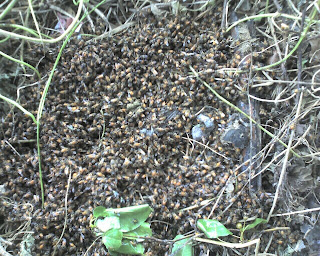
I was really bummed and pissed at myself for making such a stupid mistake. I should have either put them in a bigger box immediately or maybe kept them in the air-conditioned house for the night. Like everything in this beekeeping adventure, I chalk it up to a lesson learned - one I will not forget.
Fortunately there was a bit of good news - earlier this summer a bunch of us from the Philadelphia Beekeepers Guild were interviewed by a reporter for United Airlines Hemispheres Magazine. They were doing a feature article on urban beekeeping in Philadelphia. The article was published in the August issue and you can read it here. It is a great article with amazing photos that were taken by Keliy Anderson-Staley with an old view camera and processed on glass plate negatives. You can read more about the camera and the developing process here and also see some of the photographers other work.
So goes life, so goes beekeeping - gotta take the good with the bad.
At about 11 AM the next day I went to get the nuc box and bring it to one of my apiaries to set up a new hive and install the swarm. When I grabbed the nuc box I saw something that kind of didn't look right - there were a bunch of lifeless looking bees hanging out near the screened entrance. I took a quick peak inside and I saw a mass of soggy-looking, lifeless bees on the floor of the nuc. I rushed to try to take them to the apiary, not knowing that at that point, 95% of the bees were already dead.
When I got to the apiary I finally opened the box totally and saw for sure what I had feared - I had killed the bees, basically cooked them. I thought that they would be OK in the little nuc box for one night and I thought that there was enough ventilation, but apparently I was wrong. Sorry girls :(
This is what the bees looked like when I dumped them out -


I was really bummed and pissed at myself for making such a stupid mistake. I should have either put them in a bigger box immediately or maybe kept them in the air-conditioned house for the night. Like everything in this beekeeping adventure, I chalk it up to a lesson learned - one I will not forget.
Fortunately there was a bit of good news - earlier this summer a bunch of us from the Philadelphia Beekeepers Guild were interviewed by a reporter for United Airlines Hemispheres Magazine. They were doing a feature article on urban beekeeping in Philadelphia. The article was published in the August issue and you can read it here. It is a great article with amazing photos that were taken by Keliy Anderson-Staley with an old view camera and processed on glass plate negatives. You can read more about the camera and the developing process here and also see some of the photographers other work.
So goes life, so goes beekeeping - gotta take the good with the bad.
Thursday, July 29, 2010
Swarm!
A swarm in May is worth a load of hay, a swarm in June is worth a silver spoon, but a swarm in July isn't worth a fly - so the saying goes. Well, I just got myself a fly! Yesterday while I was at work I got a call from Abigail about a swarm of bees on her block near 21st and Fitzwater. I couldn't leave work until 7:00 so I was hoping the bees stayed put and fortunately they did. My first chance for a swarm capture - I was pretty damn excited.
I loaded up the car with equipment and the family and headed across town. We arrived and saw the smallish swarm about 12 feet up in a Callery Pear tree (it's the light brown colored mass at the top of the picture) -

Here's a close-up -

I only had a 6 foot ladder which wouldn't be high enough. My lovely wife had the idea of pulling the car underneath the swarm and putting the ladder on top of the car. Then, helpful neighbors Abigail and Chad grabbed a perfect sized piece of plywood to put under the ladder to give it some extra stability. Here's the set-up -
The swarm was very mellow (as they usually are), it's an amazing site to see this roiling mass of bees hanging out on a tree limb. Swarms are usually not aggressive because they have no home to defend and, before they leave their home hive they fill up their bellies with honey for the trip into the unknown and this helps keep them calm (like the post-Thanksgiving dinner kind of feel). So all I had to do was clip the branch off and drop it into a nuc box that I had handy. The scariest part wasn't the bees but being on the ladder, on top of the car.
Here are the girls in the nuc. I would say that 95% of them stayed on the branch as I dropped it into the box. The few that were flying eventually made their way into the box on their own.

Again, none of the bees were at all aggressive, they paid virtually no mind to any of the humans nearby. I had about 50 on my hand at one point but they were just hanging out, not trying to sting me.

So my job for today is to get this swarm set up in a new home. There is a good chance that they will not make it through the winter because they won't have enough time or population to build a strong colony but I figure it's worth a try. Worst case scenario is that maybe they will draw some nice honeycomb for me that I can use in the future.
Here's helpful neighbor Chad, first time wearing a veil. Thanks again for the help!

I loaded up the car with equipment and the family and headed across town. We arrived and saw the smallish swarm about 12 feet up in a Callery Pear tree (it's the light brown colored mass at the top of the picture) -

Here's a close-up -

I only had a 6 foot ladder which wouldn't be high enough. My lovely wife had the idea of pulling the car underneath the swarm and putting the ladder on top of the car. Then, helpful neighbors Abigail and Chad grabbed a perfect sized piece of plywood to put under the ladder to give it some extra stability. Here's the set-up -
The swarm was very mellow (as they usually are), it's an amazing site to see this roiling mass of bees hanging out on a tree limb. Swarms are usually not aggressive because they have no home to defend and, before they leave their home hive they fill up their bellies with honey for the trip into the unknown and this helps keep them calm (like the post-Thanksgiving dinner kind of feel). So all I had to do was clip the branch off and drop it into a nuc box that I had handy. The scariest part wasn't the bees but being on the ladder, on top of the car.
Here are the girls in the nuc. I would say that 95% of them stayed on the branch as I dropped it into the box. The few that were flying eventually made their way into the box on their own.

Again, none of the bees were at all aggressive, they paid virtually no mind to any of the humans nearby. I had about 50 on my hand at one point but they were just hanging out, not trying to sting me.

So my job for today is to get this swarm set up in a new home. There is a good chance that they will not make it through the winter because they won't have enough time or population to build a strong colony but I figure it's worth a try. Worst case scenario is that maybe they will draw some nice honeycomb for me that I can use in the future.
Here's helpful neighbor Chad, first time wearing a veil. Thanks again for the help!

Wednesday, June 9, 2010
Growing Up

In the last week I have checked on all 5 hives and they are all doing well. I have added new boxes to all of the hives as they grow their population. The queens need room to lay more eggs so that the colonies can expand and prepare for the rest of the nectar flow. Some of the hives were stronger than others, some had better laying queens but we'll see how the hives progress through the rest of the summer. There is a bunch of honey in the hive at my house and the larger two hives at the Field St site. I am going to harvest some of it next week and bring it to the next meeting of the Beekeepers Guild. We are going to do an extraction demo and I will be doing the crush and strain method. We'll also demo how to use a honey extractor.

For the most part things were unremarkable when I checked on each hive, but one of the hives at Folsom St (this is the site where the tree was cut down) was sharing its home. I opened the hive to see tens of thousands of little black ants and their eggs scurrying around on the inner cover of the hive (unfortunately I didn't get any pictures). It looked as though they were living in the outer cover - between the aluminum and wood. I quickly took the cover and dumped it off on the other side of the park. The bees didn't seemed bothered by the ants but this hive did seem a little weaker than the one right next to it. There are so many variables that it's hard to know if the ants were a problem. (I have been back to check on this hive and it is fine. The ants are gone and the bees are carrying on with their business.)
Here are a few other observations and pictures.
We had some really hot days in the past few weeks, some near 90 degrees. On one of those days I was watching the hive on the roof and I saw this -

Look closely at the front of the hive and you will see a bunch of the girls with their butts sticking up and facing outwards from the opening of the hive. They move their wings while they are in this position in order to create a current of air to help keep the hive cool on really hot days. Basically, air conditioning!
In this shot you can see a new bee about to emerge from its cell. On the left side of the photo look at the cell with the little hole in it. The bee is chewing her way out the cell in order to join her sisters. Pretty amazing to watch (I tried video but my little camera didn't do well with the close up). The glistening liquid in the adjacent cells is nectar on its way to becoming honey - yum!!

Here is some beautiful foundationless comb being drawn. These are the Carniolan bees from Vermont - you can notice that some of the bees are much darker, almost grayish-black in color.

On this particular day of inspections, I did take a few stings. You can see how I react - my left hand took one sting on the knuckle.

This was about 24 hours after the sting, when the swelling was at its worst. The itching wasn't too bad this time. I am hoping that as time goes on and I get stung more that my reaction is not quite as severe. From what I gather, it can go either way - you can become less sensitive or more sensitive.
Thanks to fellow Guild member Dave Harrod, I found a book called Clan Apis - it is a graphic novel that basically describes in accurate detail what life is like inside of a honeybee colony, told through the eyes and mouth of "Nyuki" the honeybee. It is an entertaining and informative read. I am currently reading it to my daughter and she loves it. To get a sense of his style, click on Clan Apis link above and then click the link on the right called "Killer Bee" and you can read a true story about the author (a bee researcher) rendered in his cartoon style.
Thursday, May 6, 2010
From the Green Mountains to the Concrete Jungle
I promised more stories so here they are...
When I ordered bees way back in February, like last year I ordered two packages from the Seaborns in Tennessee and I ordered two small-cell nucs from Denny White in Williamsville, VT. Small-cell nucs are not easy to find and Denny does not ship bees so I would need to drive to Vermont to pick them up - a bit of a long drive but I figured it would be a beautiful one.
So I left Philly on Saturday afternoon and drove to Pittsfield, MA where I spent the night with my friend Nicole (thanks Nicole!). Then I woke up early and drove 2 more hours to get to Williamsville. I arrived and Denny was ready to pack up the nucs for the trip back to Philly. I was picking up two for me and two for another member of the Philadelphia Beekeeping Guild. We drove a short distance from Denny's house to one of his beeyards. The setting was absolutely beautiful and idyllic - all I could think was "Wow, these bees are going to have a much different view when we get back home!"


Being up in the mountains presents different challenges than urban beekeeping. Denny has had bears disturb his hives in the past. The white fence is electrified and that slab of meat on the fence is bacon - the idea being to get the bears to go after the bacon and touch the fence and ZAP!

As we packed up the nucs Denny and I had a little chance to talk about beekeeping and related topics. He is a great guy and I could tell by the way he handled the bees and talked about them that he really cares deeply for the bees. I think I could learn a ton from him and it's too bad we don't live closer - he would be a great mentor. It is not easy to find people who have a lot of experience practicing small-cell, organic beekeeping and Denny is one of those people.
After packing up all of the bees and making sure there were no holes for the girls to escape from, we loaded them in the car. I drove home with 50,000 or so bees riding in the trunk behind me. Fortunately we had done a good job sealing them up!

After about 5.5 hours driving, I was back in Philly. I installed the bees in their new home right away - with some help from my assistant. This site is a small abandoned park a few blocks from the other site. Penny is planning on using it as a staging area for plants for her greening projects and also for raising cut flowers.


Here's a good shot of the queen - she is marked with a blue dot. This makes her easier to find but also each year has a designated color so that you can know how old your queen is.

The installation went very smoothly. The bees were mellow and no stings at all. They were set up in their new city home. I came back the next day to check on them and to feed them some honey to help get them started. Much to my surprise, I arrived to a scene of destruction. This was the view right outside the park.

Somehow, one day after I installed the bees, the owner of the vacant lot next to the park had decided he wanted to have the LARGE tree, which overhung the park, cut down. I mean, give me a freakin' break - look at that tree, it has to be at least 15 years old if not more. What are the chances that the day after the beehives were installed, the tree has to get cut down? I go inside the park and this is what I see - a large branch at least 6 inches in diameter is literally touching one of the hives. The hive had moved a few inches but nothing was broken or damaged - unbelievable! A few more inches and the hive could have been toast!

I was in complete shock. I called Penny and she had no idea that this was going to happen. The guys that were cutting down the tree had no idea there were bees in the park, just a few feet from the tree they were cutting down. I showed them and they came in and cleaned up the area and were more careful with finishing their job.
So, the Green Mountain bees got a rude introduction to city life, but I think it will just make them tougher! The plan for now is to keep them in this spot, but as I have quickly learned, with beekeeping you never know what will happen next!!
When I ordered bees way back in February, like last year I ordered two packages from the Seaborns in Tennessee and I ordered two small-cell nucs from Denny White in Williamsville, VT. Small-cell nucs are not easy to find and Denny does not ship bees so I would need to drive to Vermont to pick them up - a bit of a long drive but I figured it would be a beautiful one.
So I left Philly on Saturday afternoon and drove to Pittsfield, MA where I spent the night with my friend Nicole (thanks Nicole!). Then I woke up early and drove 2 more hours to get to Williamsville. I arrived and Denny was ready to pack up the nucs for the trip back to Philly. I was picking up two for me and two for another member of the Philadelphia Beekeeping Guild. We drove a short distance from Denny's house to one of his beeyards. The setting was absolutely beautiful and idyllic - all I could think was "Wow, these bees are going to have a much different view when we get back home!"


Being up in the mountains presents different challenges than urban beekeeping. Denny has had bears disturb his hives in the past. The white fence is electrified and that slab of meat on the fence is bacon - the idea being to get the bears to go after the bacon and touch the fence and ZAP!

As we packed up the nucs Denny and I had a little chance to talk about beekeeping and related topics. He is a great guy and I could tell by the way he handled the bees and talked about them that he really cares deeply for the bees. I think I could learn a ton from him and it's too bad we don't live closer - he would be a great mentor. It is not easy to find people who have a lot of experience practicing small-cell, organic beekeeping and Denny is one of those people.
After packing up all of the bees and making sure there were no holes for the girls to escape from, we loaded them in the car. I drove home with 50,000 or so bees riding in the trunk behind me. Fortunately we had done a good job sealing them up!

After about 5.5 hours driving, I was back in Philly. I installed the bees in their new home right away - with some help from my assistant. This site is a small abandoned park a few blocks from the other site. Penny is planning on using it as a staging area for plants for her greening projects and also for raising cut flowers.


Here's a good shot of the queen - she is marked with a blue dot. This makes her easier to find but also each year has a designated color so that you can know how old your queen is.

The installation went very smoothly. The bees were mellow and no stings at all. They were set up in their new city home. I came back the next day to check on them and to feed them some honey to help get them started. Much to my surprise, I arrived to a scene of destruction. This was the view right outside the park.

Somehow, one day after I installed the bees, the owner of the vacant lot next to the park had decided he wanted to have the LARGE tree, which overhung the park, cut down. I mean, give me a freakin' break - look at that tree, it has to be at least 15 years old if not more. What are the chances that the day after the beehives were installed, the tree has to get cut down? I go inside the park and this is what I see - a large branch at least 6 inches in diameter is literally touching one of the hives. The hive had moved a few inches but nothing was broken or damaged - unbelievable! A few more inches and the hive could have been toast!

I was in complete shock. I called Penny and she had no idea that this was going to happen. The guys that were cutting down the tree had no idea there were bees in the park, just a few feet from the tree they were cutting down. I showed them and they came in and cleaned up the area and were more careful with finishing their job.
So, the Green Mountain bees got a rude introduction to city life, but I think it will just make them tougher! The plan for now is to keep them in this spot, but as I have quickly learned, with beekeeping you never know what will happen next!!
Wednesday, May 5, 2010
Bees That Way Sometimes
My stepdad has all these crazy sayings that he spouts when he wants to succintly comment on some absurdity of life (actually, usually he just says them because he likes to say them). Last week he busted one out that I hadn't heard in a while "Be(e)s that way sometimes" - now with my new hobby, that saying has taken on new meaning! (One of my other favorites is: "It's not so oft the cough that takes you off, it's more often the coffin they take you off in.)
What a spring we are having - the bees are loving it - the pollen and nectar are flowing and they are busy working. We have had some really hot days already - this past weekend it felt like July. We've also had some good rain, which will ensure that a good nectar flow continues for the bees.
With all of the crazy snow we had this winter, our roof sprang a few small leaks. I enlisted the help of Cory Suter, from BioNeighbors, to repair our roof. We agreed on him installing an environmentally friendly white roof coating. Other than Cory deciding to move the beehive by himself and getting stung on the head, everything went smoothly! The bees are happy with their new, cooler roof -

Unfortunately I will no longer be keeping bees at The Spring Gardens community garden. After the hive there died, I decided that I didn't want to keep trudging up to the top of that shipping container where the hive was. It was a pain in the ass and I didn't feel very safe up there either. I asked them if we could find a new spot within the garden for the hive but they were unwilling to allow the bees to be anywhere but up on the shipping container. It's kind of a shame because the garden is a great place and I would love to be able to keep bees there and use the hive as an educational tool. Oh well, their loss.
The good news is that I have made a great contact in our neighborhood who is totally supportive of the bees. Her name is Penny Giles - community activist, environmentalist, general go-getter and I would say, unofficial mayor of Francisville (this is the name of the neighborhood where I live). Penny has found me two sites where I can keep hives and I have already set up two hives at each of the new sites for a total of 4 new hives.
Here are some shots of the first spot. Penny is planning on putting in a bunch of grapevines and other garden beds in this lot -


While I was cleaning up the site, I saw a couple of these little guys - kind of cool to see them in the city. As totem animals, snakes are a sign of change - and change is coming to this run-down lot - so I saw it as a good sign.

Here are the two hives -

While installing the packages of bees, I royally screwed up the entire process. I lost one of the queens (she flew away!) and almost lost the other (so I had to order one replacement queen). In addition to that, I was stung 8 times on the head and face, which was tons 'o fun - here's a look -

Speaking of stings - here is a great article on remedies for bee stings - the winner for best drug remedy was caladryl and the best home remedy, toothpaste!
Something interesting happened while I was waiting for the replacement queen to arrive. I went back to check on the hives one week after installing them and I saw that the hives were incredibly unequal in terms of population. About 2/3 of the bees from the queenless hive had migrated to the queenright hive. This left the queenless hive very weak and low in population. But, because the queenright hive had so many bees, they were able to fill ten frames of comb with nectar and brood in just one week (that is fast!). Once the new queen arrived, I did a little switcheroo to try to equalize the populations of the hives. I installed the new queen and then swapped the positions of the two hives. Now, when all of the field bees from the strong hive returned they would, unbeknownst to them, become part of the weak hive. Well, it worked. I did that maneuver about two weeks ago and I checked on those hives today. The populations are not totally even but they are much closer than they were. The strong hive is still really strong and the other one is now about average size.
So, lessons learned from this adventure - wear my veil, be better prepared, don't rush, stay calm and most of all, be very careful with the queen!
I have some good stories from installing the other hives too, but I will post those adventures later.
What a spring we are having - the bees are loving it - the pollen and nectar are flowing and they are busy working. We have had some really hot days already - this past weekend it felt like July. We've also had some good rain, which will ensure that a good nectar flow continues for the bees.
With all of the crazy snow we had this winter, our roof sprang a few small leaks. I enlisted the help of Cory Suter, from BioNeighbors, to repair our roof. We agreed on him installing an environmentally friendly white roof coating. Other than Cory deciding to move the beehive by himself and getting stung on the head, everything went smoothly! The bees are happy with their new, cooler roof -

Unfortunately I will no longer be keeping bees at The Spring Gardens community garden. After the hive there died, I decided that I didn't want to keep trudging up to the top of that shipping container where the hive was. It was a pain in the ass and I didn't feel very safe up there either. I asked them if we could find a new spot within the garden for the hive but they were unwilling to allow the bees to be anywhere but up on the shipping container. It's kind of a shame because the garden is a great place and I would love to be able to keep bees there and use the hive as an educational tool. Oh well, their loss.
The good news is that I have made a great contact in our neighborhood who is totally supportive of the bees. Her name is Penny Giles - community activist, environmentalist, general go-getter and I would say, unofficial mayor of Francisville (this is the name of the neighborhood where I live). Penny has found me two sites where I can keep hives and I have already set up two hives at each of the new sites for a total of 4 new hives.
Here are some shots of the first spot. Penny is planning on putting in a bunch of grapevines and other garden beds in this lot -


While I was cleaning up the site, I saw a couple of these little guys - kind of cool to see them in the city. As totem animals, snakes are a sign of change - and change is coming to this run-down lot - so I saw it as a good sign.

Here are the two hives -

While installing the packages of bees, I royally screwed up the entire process. I lost one of the queens (she flew away!) and almost lost the other (so I had to order one replacement queen). In addition to that, I was stung 8 times on the head and face, which was tons 'o fun - here's a look -

Speaking of stings - here is a great article on remedies for bee stings - the winner for best drug remedy was caladryl and the best home remedy, toothpaste!
Something interesting happened while I was waiting for the replacement queen to arrive. I went back to check on the hives one week after installing them and I saw that the hives were incredibly unequal in terms of population. About 2/3 of the bees from the queenless hive had migrated to the queenright hive. This left the queenless hive very weak and low in population. But, because the queenright hive had so many bees, they were able to fill ten frames of comb with nectar and brood in just one week (that is fast!). Once the new queen arrived, I did a little switcheroo to try to equalize the populations of the hives. I installed the new queen and then swapped the positions of the two hives. Now, when all of the field bees from the strong hive returned they would, unbeknownst to them, become part of the weak hive. Well, it worked. I did that maneuver about two weeks ago and I checked on those hives today. The populations are not totally even but they are much closer than they were. The strong hive is still really strong and the other one is now about average size.
So, lessons learned from this adventure - wear my veil, be better prepared, don't rush, stay calm and most of all, be very careful with the queen!
I have some good stories from installing the other hives too, but I will post those adventures later.
Subscribe to:
Posts (Atom)